
Wokingham Borough Council will put up to £5m into EV charging with a private partner, aiming for over 400 chargepoints by 2030. A partner is due by spring.
Wokingham Borough Council will spend up to £5 million on public electric vehicle charging, alongside a private partner that is expected to put in about the same. The Executive approved the plan on 29 October. The council wants the partner in place by spring 2027.
The council’s target is more than 400 chargepoints across the borough by 2030. It has about 90 now.
The aim is to help people without a driveway. The council’s report says the need is greatest in Wokingham, Winnersh, Woodley, Earley and Twyford, where many homes have nowhere to charge off the street.
What the Executive agreed
The decision sheet records three decisions:
- A single partner will be appointed through an open tender, to finance, build, run and expand the network for 15 years. The council can extend that by up to five years.
- Up to £5 million of council money, moved from an existing energy efficiency budget. The partner is expected to match it on a roughly 50:50 basis.
- The contract award is delegated to the council’s deputy chief executive, provided the final deal is affordable and good value.
That £5 million does not include the solar-powered charging hub already approved for the Mereoak park and ride near the M4.
What is there now
The Executive report says the council has influence over about 90 publicly available chargepoint units:
- About 46 are owned by the council.
- About 44 were installed under a government on-street residential scheme and are owned and run by a private company.
Only a small number are rapid chargers. The report says the existing network brings the council “only limited direct financial benefit”. The operator keeps the income from the privately owned units, and the council’s own units have to cover electricity, repairs and back-office costs.
The council’s own chargepoints are expected to move into the new partnership. The private on-street scheme will carry on separately for now.
What could be built
The partner would be expected to offer every kind of charging:
- on-street and neighbourhood chargers for homes without off-street parking
- cross-pavement charging, where a resident charges from their own home electricity supply across the pavement
- chargers at council car parks, leisure centres, shops and community sites
- rapid and ultra-rapid chargers on main routes
- larger charging hubs linked to solar power
Every proposed site will need local consultation before anything is installed, the report says. The council keeps the right to approve each site.
No total number of chargers has been set. The council’s announcement says it “hopes to achieve its target of more than 400 chargepoints by 2030”. Its 2025 strategy goes further: in its high-demand scenario, the borough would need about 1,392 fast charging sockets and 320 rapid or ultra-rapid sockets by 2030. Those figures count private chargers as well as public ones.
Who sets the price
The report says the council will have an equal say with the partner on charging tariffs. It says prices must stay “fair and competitive for residents”, but also warns that prices which put people off would undermine the network’s finances.
The partner may own the chargers during the contract. At the end, they would normally pass to the council for nothing or a nominal sum. The deal will not give the partner a monopoly across the borough.
The money
The council expects the network to make it money. Its report models a £10 million programme, half from council borrowing and half from the partner, with the council taking half of the operating surplus.
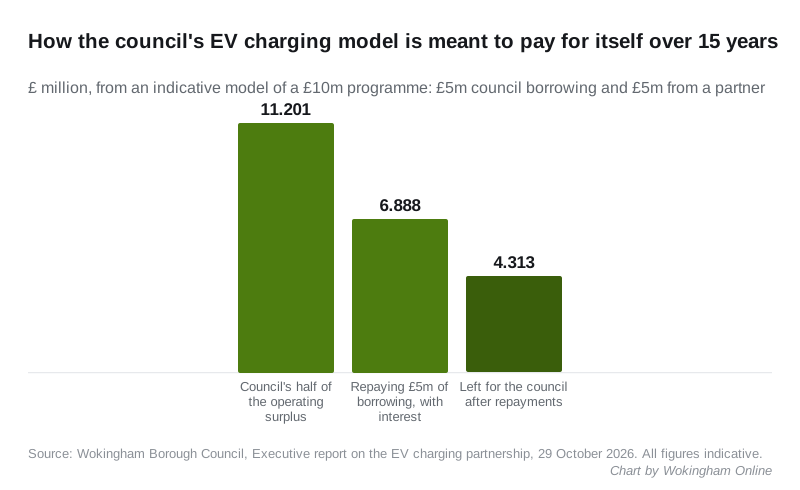
On those assumptions, over 15 years:
- the programme makes an operating surplus of about £22.4 million
- the council’s half is about £11.2 million
- repaying its borrowing costs about £6.9 million, including £1.9 million of interest at an average 4.3%
- that leaves the council about £4.3 million, or £288,000 a year on average
The council’s spending is pencilled in at about £1.5 million in each of the first two years and £1 million in the third, with £1 million held back for later. The report stresses that all of this is indicative and depends on the bids. Bids will be scored 60% on cost and the financial model and 40% on quality, after a pass or fail check that each bidder can raise the money.
The council has also been given government Local Electric Vehicle Infrastructure funding for chargers for residents without off-street parking. The report says it will use that money if it fits the partnership, and would hand it back if it does not.
Why the council says it is needed
The council’s 2025 strategy forecasts about 40,000 electric cars registered in the borough by 2030, more than 30% of all cars. It says that switch would save more than 63,000 tonnes of carbon a year, over 44% of the savings in the council’s climate emergency action plan.
Cllr Adrian Betteridge, executive member for active travel, transport and highways, said the council had “learned valuable lessons from our initial, smaller-scale EV charging provision”. He added: “Now we’re ready to scale up our support through a strategic partnership.”
Cllr Imogen Shepherd-DuBey, executive member for finance and governance, said the scheme “will take time to implement while bids are fairly considered and details of any partnership arrangement are negotiated”.
What it means for you
- No new chargers yet. This is the start of a tender. The council expects to pick a partner by spring 2027, and sites will be decided after that.
- If you have no driveway, this scheme is aimed at you. Cross-pavement charging is one of the options bidders must offer.
- You will be asked first. Each new charging site needs local consultation before it is installed.
- Charging prices are not set. The council will share the say on tariffs with the partner.
For parking in the town centre and at the park and rides, see our parking in Wokingham guide.
Sources
- Wokingham Borough Council, Executive decision sheet, 29 October 2026 (item 68)
- Wokingham Borough Council, Borough-wide Electric Vehicle Charging Strategic Infrastructure Partnership Procurement, Executive report, 29 October 2026 (existing units, scope, tariffs, financial model, evaluation, LEVI funding, 2030 forecasts)
- Wokingham Borough Council, Ambitious vision to roll out electric vehicle charging, 3 November 2026 (400 chargepoint target, spring 2027, quotes)
Have your say