
2,340 Wokingham borough residents claimed out-of-work benefits in October, the most since September 2021. Claims by 16 to 24 year olds are up by almost a fifth.
2,340 people in Wokingham borough were claiming benefits mainly because they were out of work in October 2026. That is the highest count since September 2021, when the borough was still coming down from its pandemic peak.
The Office for National Statistics published the figures on Tuesday 17 November. The count is 2.0 per cent of residents aged 16 to 64, still the lowest rate in Berkshire (ONS claimant count via nomis).
Overview
- October 2026: 2,340 claimants, 2.0% of 16 to 64 year olds.
- On the month: up 40 from 2,300 in September.
- On the year: up 150 from 2,190 in October 2025, a rise of 6.8%.
- The change to watch: 475 claimants aged 16 to 24, the most since August 2021.
A slow climb, not a jump
The borough’s count has edged up for most of the past three years. It was 1,885 in October 2023 and 2,170 in October 2024 (ONS via nomis, monthly series).
The last time the figure was higher was September 2021, at 2,405. At the height of the pandemic, in August 2020, it reached 3,685. Before Covid, in January 2020, it was 1,105.
The ONS has revised September’s figure. It was first published as 2,325 and now stands at 2,300. October’s figure may be revised in the same way next month.
Young claimants up by almost a fifth
The rise over the year is concentrated at the two ends of the working age range (ONS via nomis, by age).
| Age band | October 2025 | September 2026 | October 2026 |
|---|---|---|---|
| 16 to 24 | 400 | 455 | 475 |
| 25 to 49 | 1,255 | 1,240 | 1,250 |
| 50 and over | 535 | 610 | 610 |
| All ages | 2,190 | 2,300 | 2,340 |
- 16 to 24: up 75 on the year, a rise of 19%. The last time the count was higher was August 2021, at 490.
- 50 and over: up 75 on the year. The count has been 610 for two months, the highest since September 2021.
- 25 to 49: five fewer than a year ago.
Which wards have the highest rates
The ONS also publishes the count for each of the borough’s 18 wards. The rate runs from 1.2 per cent in Hillside to 2.9 per cent in Bulmershe and Coronation, in Woodley (ONS via nomis, Wokingham wards).
| Ward | Claimants | Rate |
|---|---|---|
| Bulmershe and Coronation | 160 | 2.9% |
| Norreys | 160 | 2.6% |
| Maiden Erlegh and Whitegates | 165 | 2.4% |
| Shinfield | 190 | 2.4% |
| South Lake | 145 | 2.4% |
| Barkham and Arborfield | 155 | 2.3% |
| Winnersh | 165 | 2.3% |
Shinfield has the largest number of claimants of any ward, at 190. The lowest rates are in Hillside, at 1.2 per cent, and in Twyford, Ruscombe and Hurst, at 1.6 per cent. Wescott and Spencers Wood and Swallowfield are both at 1.7 per cent.
Ward counts are rounded to the nearest five, so the 18 wards add up to 2,345 rather than the borough’s 2,340.
Wokingham and its neighbours
Every Berkshire authority saw its count rise in October. Wokingham’s rate is half the England figure (ONS via nomis, Berkshire and comparators).
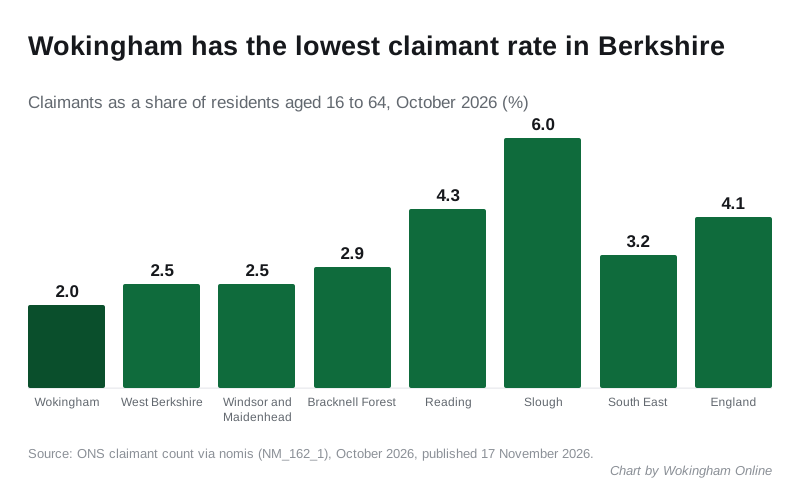
| Area | September 2026 | October 2026 | Rate |
|---|---|---|---|
| Wokingham | 2,300 | 2,340 | 2.0% |
| West Berkshire | 2,415 | 2,490 | 2.5% |
| Windsor and Maidenhead | 2,395 | 2,510 | 2.5% |
| Bracknell Forest | 2,410 | 2,425 | 2.9% |
| Reading | 5,280 | 5,460 | 4.3% |
| Slough | 6,410 | 6,560 | 6.0% |
| South East | 183,385 | 187,915 | 3.2% |
| England | 1,467,420 | 1,497,710 | 4.1% |
Wokingham’s rise of 40 in the month was the second smallest in Berkshire, after Bracknell Forest’s 15. Windsor and Maidenhead rose by 115 and Reading by 180.
What it means for you
The claimant count is not the same as unemployment. It counts people on Jobseeker’s Allowance, plus people on Universal Credit who are required to look for work. Some of them are in low-paid work and looking for more hours.
Anyone who has lost work can check what they are entitled to with the government’s benefits calculators. The Universal Credit pages on GOV.UK explain how to claim. Wokingham’s nearest Jobcentre Plus offices are listed on the government’s Jobcentre finder.
The next figures, for November, are due from the ONS in December.
Have your say